
Answer Engine Optimization (AEO) is an important part of modern digital marketing. It helps businesses create clear, useful content that search engines and AI-powered platforms can understand when answering users’ questions. As people increasingly use conversational searches to find information, businesses need to make their websites more helpful and relevant.
For example, someone might search for the best way to learn digital marketing, ask an AI assistant to compare courses, or look for practical SEO advice. These changing search habits create new opportunities for businesses that publish reliable and informative content.
At DMIK, a digital marketing institute in Kota, we believe that understanding Answer Engine Optimization (AEO) helps students, bloggers, and business owners build a stronger search strategy. By focusing on real user questions and providing direct answers, businesses can improve their content and prepare for evolving search experiences.
What Is Answer Engine Optimization (AEO)?
Answer Engine Optimization (AEO) is the practice of organizing and improving website content so that search engines and answer-focused platforms can understand it and potentially use it to answer users’ questions.
Traditional SEO focuses on improving a website’s visibility in search results. AEO adds another consideration: whether the content clearly answers the questions people are asking.
For example, a website may publish an article about digital marketing courses. Instead of discussing only general benefits, the article can answer practical questions about course duration, skills taught, fees, projects, and career opportunities.
Clear answers make the content more useful for readers. They also help search systems understand what a page covers.
However, no optimization technique guarantees that a website will appear in an AI-generated answer. Google confirms that established SEO practices remain important for its AI-powered search features.
Why Is AEO Important in 2026?
People increasingly use conversational searches to research products, services, education, and business decisions. They may ask follow-up questions instead of searching for every detail separately.
This creates an opportunity for websites to provide detailed, trustworthy information.
Here are four reasons businesses should pay attention to AEO.
1. Better answers for users
Visitors can find relevant information without searching through long, confusing paragraphs. Direct answers improve the reading experience.
2. Stronger content structure
Question-based headings, descriptive subheadings, and well-organized explanations make pages easier to navigate.
3. Opportunities in AI-powered search
Search experiences such as Google AI Overviews and AI Mode may show links to relevant supporting websites. Helpful, crawlable content can be eligible for consideration.
4. More useful website content
Writing around real customer questions helps businesses address common concerns before visitors contact them.
Remember that AEO is not a replacement for SEO. Technical performance, indexing, useful content, and website credibility remain important.
How Does AEO Work?
Answer-focused search systems need to identify relevant information and understand whether it helps answer a particular question.
A website can support this process by making its content clear and reliable.
For example, consider the question, “What skills do you learn in a digital marketing course?”
A weak page might discuss digital marketing generally without answering the question. A stronger page would explain SEO, social media marketing, paid advertising, analytics, content creation, and practical campaign management.
The stronger page gives readers a more complete answer.
To improve your content, follow these steps:
- Identify the questions your audience asks.
- Create a clear heading for each important topic.
- Answer the main question near the beginning of the relevant section.
- Add examples, supporting details, and practical steps.
- Link to relevant pages on your website.
- Check facts and update outdated information.
- Make sure search engines can crawl and index the page.
These steps improve usefulness and clarity. They do not guarantee a featured answer or an AI citation.
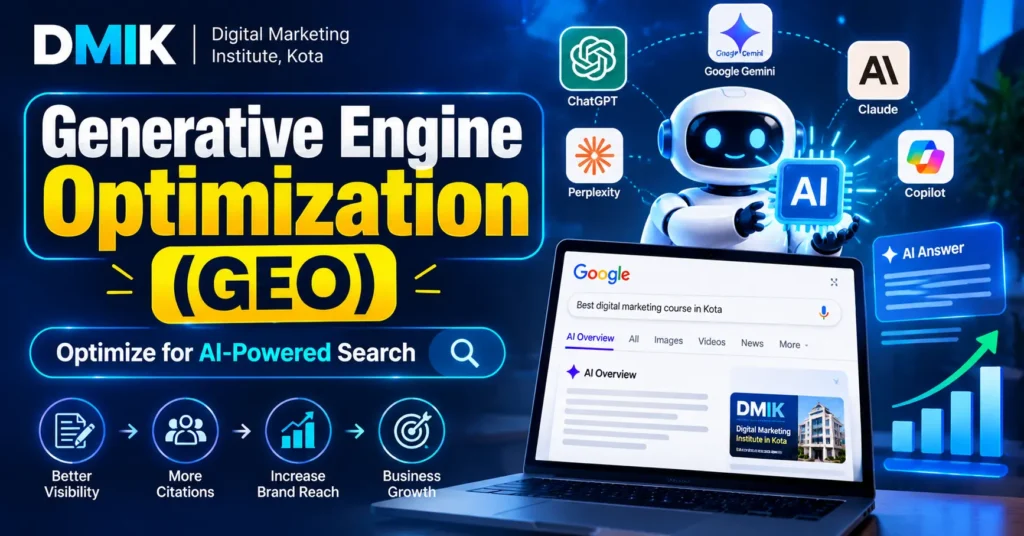
What Is GEO (Generative Engine Optimization)?
Generative Engine Optimization (GEO) refers to efforts to improve a website’s chances of being discovered, referenced, or cited in generative AI experiences.
These experiences can provide summarized answers using information from multiple sources. Users may then follow links to explore the original websites.
For example, someone might ask an AI assistant to compare digital marketing training options in Kota. A helpful page that clearly explains its courses, teaching approach, projects, and other relevant details could provide useful information for that research.
This does not mean the page will automatically be selected or cited. AI systems use different methods, and their responses can change.
What Is the Difference Between AEO and GEO?
AEO and GEO overlap, but they emphasize slightly different goals.
AEO focuses on answering questions clearly. It encourages content that directly addresses user needs.
GEO focuses on visibility within generative AI experiences. It considers whether useful content can be discovered and referenced when AI systems generate responses.
For example, an FAQ explaining how keyword research works supports an AEO approach. A detailed, evidence-based guide that an AI-powered search experience may reference also supports a GEO approach.
In practice, both approaches benefit from strong SEO fundamentals. Website owners should prioritize useful information instead of relying on shortcuts or unsupported promises about AI rankings.
AEO vs GEO vs Traditional SEO
These approaches work best when treated as complementary parts of a content strategy.
| Approach | Main focus | Example |
|---|---|---|
| Traditional SEO | Search visibility and relevant organic traffic | Optimizing a page for a relevant search query |
| Answer Engine Optimization (AEO) | Clear answers to users’ questions | Creating helpful question-and-answer sections |
| Generative Engine Optimization (GEO) | Visibility and citations in AI-generated responses | Publishing a detailed guide with reliable information |
A single well-written page can support all three approaches.
For example, a guide about learning SEO can target a relevant search keyword, answer common student questions, and provide detailed explanations that are useful in AI-powered search experiences.
The important thing is to create content for people first and make it easy for search systems to understand.
How to Optimize Your Website for AEO and GEO
You do not need to rebuild your entire website to start improving its content. Begin with the pages that matter most to your audience.
1. Research Real Questions
Use Google Search suggestions, relevant search results, customer enquiries, and Google Search Console data to understand what people want to know.
Choose questions that match your audience and business. Avoid adding unrelated questions simply to increase the number of keywords on a page.
2. Write Clear, Direct Answers
Place a concise answer near the beginning of each question-based section. Follow it with examples, explanations, and practical details.
For instance, when answering “What is keyword research?”, begin with a simple definition before explaining how to identify and evaluate keywords.
3. Use Descriptive Headings
Use one clear H1 for the main topic. Organize supporting sections with H2 headings and use H3 headings when a section needs further explanation.
Headings should describe the information that follows them. Avoid repeating the same keyword unnaturally in every heading.
4. Demonstrate Experience and Expertise
Include real examples, original observations, practical screenshots, and relevant explanations from your work.
If you describe a campaign, explain the objective, actions taken, measurement method, and outcome. Only publish results that you can substantiate.
5. Strengthen Internal Linking
Connect related articles and service pages using descriptive anchor text.
For example, an article about AEO could link to a relevant SEO guide or a digital marketing course page. This helps readers discover related information and supports website navigation.
6. Improve Technical SEO
Check whether important pages are indexed, internal links work, mobile pages are usable, and the website loads reliably.
Keep essential information available in crawlable text. Use structured data only when it accurately represents the visible page content and meets the relevant guidelines.
7. Measure and Improve
Use Google Search Console to monitor search impressions, clicks, queries, and page performance. Analytics tools can help measure engagement and enquiries.
Where available, review reporting for AI search visibility. Do not assume that an increase in ordinary organic traffic proves that AI citations have increased.
8. Answer Engine Optimization (AEO)
AI SEO Tools That Can Help
AI SEO tools can make research, content planning, and website analysis more efficient. However, they should support human judgement rather than replace it.
Here are some useful options.
Google Search Console: Helps website owners review search queries, impressions, clicks, indexing, and page performance.
Google Trends: Helps compare interest in topics and explore changes in search behaviour.
Ahrefs: Supports keyword research, backlink analysis, competitor research, and content opportunity discovery.
Semrush: Provides SEO research, keyword analysis, site auditing, and competitive insights.
ChatGPT: Can help organize FAQs, brainstorm content outlines, simplify explanations, and review drafts for clarity. Important facts should still be checked before publication.
When choosing AI SEO tools, consider your actual needs, budget, and the reliability of their data. Be cautious of tools that promise guaranteed rankings or claim privileged access to Google’s internal ranking systems.
Tools can help identify opportunities, but they cannot guarantee that a page will appear in an AI-generated answer.
DMIK Practical Example: Applying AEO to a Digital Marketing Course Page
At DMIK, a digital marketing institute in Kota, a useful way to apply AEO principles is to start with the questions prospective students need answered before choosing a course.
Consider a practical implementation scenario for a digital marketing course page. This example illustrates a recommended workflow; it is not a claim of measured ranking, traffic, or lead-generation results.
Step 1: Identify student questions
Research common questions about course fees, duration, practical training, live projects, eligibility, and career opportunities.
Step 2: Improve the course page
Create clear sections explaining what students learn, how practical training works, and what information they should consider before enrolling.
Step 3: Add useful supporting content
Publish relevant guides about SEO, Google Ads, keyword research, and social media marketing. Link these guides to the course page where appropriate.
Step 4: Provide evidence
Use genuine course information, relevant project examples, authentic student feedback, and real screenshots where permission is available. Do not publish invented testimonials or unsupported success claims.
Step 5: Measure performance
Track relevant search queries, page impressions, clicks, enquiries, and conversions. Review the data over time and improve sections that do not answer users’ needs.
This approach combines traditional SEO with answer-focused content and GEO principles. It also gives DMIK a repeatable process for improving its website based on actual user questions and measurable evidence.
Common AEO Mistakes to Avoid
Businesses sometimes focus too much on optimization tricks and not enough on content quality.
Avoid these common mistakes:
- Keyword stuffing: Repeating the same phrase excessively makes content harder to read.
- Unverified claims: Publishing unsupported statistics or expertise claims can damage trust.
- Thin answers: Short definitions without useful explanations rarely meet complex user needs.
- Unnecessary AI content: Publishing large volumes of generic articles without adding value can conflict with search spam policies.
- Ignoring technical SEO: Helpful content still needs to be discoverable and eligible for indexing.
- Expecting guaranteed citations: Neither AEO nor GEO guarantees visibility in AI-generated responses.
Google’s official guidance emphasizes useful, reliable, people-first content and established SEO practices. Focus on genuine value rather than chasing unverified AEO or GEO hacks.
Conclusion
Answer Engine Optimization (AEO) is a useful way to think about how people find and consume information in modern search experiences. It encourages businesses to answer questions clearly, structure content logically, and provide information that readers can trust.
Generative Engine Optimization (GEO) extends this thinking to generative AI experiences, where useful website content may be discovered and cited as part of a generated response.
For businesses, the strongest starting point is not a collection of technical tricks. It is a website with helpful content, sound technical SEO, accurate information, and a clear understanding of customer questions.
At DMIK, a digital marketing institute in Kota, these principles can also help students understand how search strategies are evolving. By combining practical learning with evidence-based optimization, businesses can build a stronger foundation for long-term search visibility.
Frequently Asked Questions
1. What is AEO in digital marketing?
AEO stands for Answer Engine Optimization. It focuses on making website content clear and useful so search engines and answer-focused systems can understand it when responding to users’ questions.
2. What is the difference between AEO and SEO?
SEO improves a website’s overall search visibility through content, technical improvements, and other established practices. AEO emphasizes answering specific questions clearly. The two approaches overlap and work well together.
3. What is GEO in SEO?
GEO stands for Generative Engine Optimization. It refers to efforts to improve the discoverability and potential citation of website content in generative AI experiences.
4. Is AEO important in 2026?
AEO is a useful content strategy because people increasingly use conversational searches and AI-powered tools to research questions. However, results depend on content quality, relevance, technical accessibility, and the systems displaying the answers.
5. Can AEO help a small business?
Yes. A small business can answer common customer questions, explain its services clearly, publish useful local information, and improve its website structure. These steps can support both user experience and search visibility.
6. Which AI SEO tools are useful for AEO?
Google Search Console, Google Trends, Ahrefs, Semrush, and ChatGPT can support different parts of the process. Choose tools based on your requirements and verify important findings before acting on them.
7. Does AEO replace traditional SEO?
No. Traditional SEO remains important for crawling, indexing, relevant content, internal linking, and website performance. AEO adds an emphasis on clear answers rather than replacing these foundations.
8. Do FAQs guarantee AI citations?
No. FAQs can make information easier to navigate, but they do not guarantee inclusion in featured answers or AI-generated responses. Questions should be relevant and answers should be accurate.
9. How can I measure AEO performance?
Monitor search impressions, clicks, relevant queries, website engagement, and conversions. Where dedicated reporting is available, review AI citations or visibility separately. Avoid treating ordinary traffic changes as proof of AI citations.
10. Can students learn AEO at DMIK?
Students can learn the underlying skills through SEO research, content planning, website optimization, and performance measurement. At DMIK, these topics can be explored through practical digital marketing exercises and website-based examples.